 |
||||||||
| Information also in  German
and German
and English where English whereavailable |
||||||||
|
||||||||
 |
||||||||







 |
||||||
|




|
| General program | Teatro Degollado | Concert Sunday May 11 Jalisco Philarmonic
Program: Overture to “Hänsel & Gretel” Engelbert Humperdink (1854-1921) Concierto for violoncello and orchestra. Antonin Dvorak (1841-1904) I-Allegro Intermission Prelude and Love-Detath from “Tristan & Isolde” Richard Wagner (1813-1883) Symphonic Metamorphosis on themes by Carl Maria von Weber. I-Allegro JOHANNES MOSER, violonchelo Highlights of the 2006/2007 season include his debut with the New York Philharmonic Orchestra in Tokyo, a tour of Italy with Riccardo Muti and the Cherubini Orchestra, engagements with the Munich Philharmonic and Christian Thielemann, the Cleveland Orchestra and Franz Welser-Most at the Blossom Festival, the Bamburg Symphony, Vancouver Symphony and Colorado Symphony Orchestras, as well as recitals throughout Europe and chamber music performances in Verbier, Salzburg and Lucerne. Born in Munich in 1979, Johannes has been studying the cello since the age of 8 and became a student of Professor David Geringas in 1997. He also won first prize in the 2000 Davidoff Competition in Riga and the 2001 Mendelssohn competition in Berlin. His first recital disc was released by Haenssler Classics in summer 2006 with sonatas by Schostacovich, Veinberg and Boris Tschaikovski. REVIEWS Cleveland Orchestra / Franz Welser-Möst Donald Rosenberg, The Plain Dealer, July 2007 Verbier Festival Frank Cadenhead, Musical America, August 2006 London Symphony Orchestra / Valery Gergiev The Guardian, October 2005 International Tchaikovsky Competition 2002 The Strad, October 2002 Héctor Guzmán
He has been Guest Conductor of the important Symphonic orchestras in Mexico: OFUNAM, Xalapa, State of Mexico, Bellas Artes Chamber Orchestra, Monterrey, the Mexico City Philharmonic, and the National Symphonic Orchestra. He has also conducted orchestras in Dallas, San Antonio, Wheeling; the Dominican Republic National Symphony Orchestra, the Collegium Orchestra at Lichtenstein Palace in the Prague Music Academy at the Check Republic, the Japan Philharmonic, the Amadeus Orchestra, the Milan Classical Orchestra in Italy and the Murcia Symphonic in Spain among others. In 2005 he made his operatic debut with the opera The Barber of Seville, and in 2007 conducted the premiere in Mexico of the Spanish version of ‘Frida’, a very successful opera. Recognized for his international work, he has received prizes such as the Lira de Oro in Mexico, the Meadows Award, the ‘Director par Excellence’ granted by the Technological De Vry Institute in the United States and the 2005 Medal to Artistic Merit, the highest decoration granted by the Government of the State of Mexico through the Music Conservatory at the State of Mexico. He was awarded the Candelario Huizar Artistic Merit Medal 2006, granted by his birth state, Zacatecas. In 2004, Héctor Guzmán was named Distinguished Citizen by the North American Association ‘Sons of the American Revolution’ for his artistic world wide level contribution. In 2000 he was included in the book ‘Great Musicians of the XX Century’, edited by the Biographical Cambridge Institute. In April 2007, Irving City and the Deputies Chamber for the State of Texas granted Maestro Guzmán a special recognition for the international level of his Artistic Career, and in 2008 he received the Mozart Medal from the Austrian Embassy, top recognition in Mexico for academic music excellence.
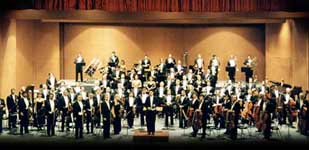
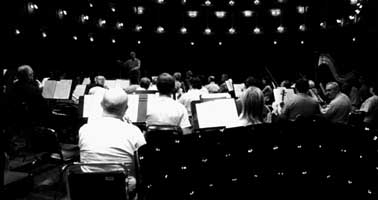
Jalisco Philarmonic Orchestra In 1915, under the initiative of Maestro José Rolón, a group of musicians from Jalisco started offering symphonic and camera concert music to Guadalajara audiences, thus establishing the starting point for what in the future would be the Guadalajara Symphonic Orchestra (Orquesta Sinfónica de Guadalajara). The orchestra was managed by the Concert Society (Sociedad de Conciertos) between 1915-1924, which had a director’s board, was sponsored by private institutions and received the State Government subsidy, interrupted in 1923 and this caused the disappearance of the organisation. Nevertheless, the musicians continued working to prevent the Orchestra from being completely obliterated, and obtained economical support from Governor José Guadalupe Zuno. It must be mentioned that Don Pedro González Peña was completely devoted to the Orchestra up to 1939.
In February 1942, while Guadalajara was celebrating its 4th Centennial, Maestro Leslie Hodge was on holiday there, and when he heard classical music played by some musicians, he approached them, willing to get acquainted encouraging them to constitute a formal orchestra. He was invited to organize it and conduct it, but at that moment he already had other commitments, promising to return after the end of World War II, and in view of this offering, the Friends of Music Association (Asociación de Amigos de la Música) requested from the Governor, Marcelino García Barragán to guarantee the survival of the orchestra until Mr. Hodge returned, and thus he became the first conductor of the Guadalajara Symphonic Orchestra. This sponsorship was sustained until 1950, year on which an association was constituted, Conciertos Guadalajara, A.C. (Guadalajara Concerts, A.C.), which sponsored the Guadalajara Symphonic Orchestra with state, municipal and private institutions funding. The Guadalajara Symphonic Orchestra became part of the Arts Department in the State of Jalisco in 19971, which since then, has taken care of its artistic level and economic concerns. Directors working with the orchestra have recognized it as adaptable and versatile, averaging 60 yearly appearances among concerts, opera and ballet. It has been conducted by famous musicians, such as Leslie Hodge, Abel Eisenberg, Helmut Goldman, Eduardo Mata, Kenneth Klein, Hugo Jan Huss, Francisco Orozco, Manuel de Elías, José Guadalupe Flores, Guillermo Salvador and Luis Herrera de la Fuente. Some of the soloists have been Paul Badura-Skoda, Claudio Arrau, Jörg Demus, Henryk Szering, Plácido Domingo; Alfred Brendel, Bernard Flavigny, Jean Pierre Rampal, and Narciso Yepez, among others.
The Guadalajara Symphonic Orchestra changed its name in 1988, giving birth to the Jalisco Philharmonic (Filarmónica de Jalisco). It was intended that the whole State of Jalisco would receive its benefits. Every member of the orchestra has been selected for the quality of auditions given by aspiring interpreters, selecting its members among the very best to guarantee uniformity in sound and technical perfection of performance each of them should have. This allows us to consider that the Jalisco Philharmonic can gallantly measure up to all kinds of repertoire, including the most ambitious modern compositions. Héctor Guzmán has been the new conductor in charge of the Jalisco Philharmonic since May 2004. |
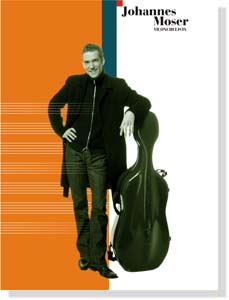
 German-born cellist Johannes Moser came to international attention in June 2002 when he won the 12th Tchaikovsky Competition and was awarded the Special Prize for his interpretation of the Rococo Variations.
  Maestro Héctor Guzmán is nowadays respected internationally as one of the most outstanding Mexican musicians and is now Conductor of the Symphonic orchestras at Plano, Irving and San Angelo in the United States. In 2004, he won the International Contest ‘Seven Conductors for a Baton’, and was officially named Conductor of the Jalisco Philharmonic Orchestra, confirming his place as one of the most important and outstanding podium figures for Mexico and the world.